Context should survive the handoff.
Project Runtime is a continuity layer for organizations. It keeps decisions, ownership, evidence and relationships connected as work moves across people, tools and time.
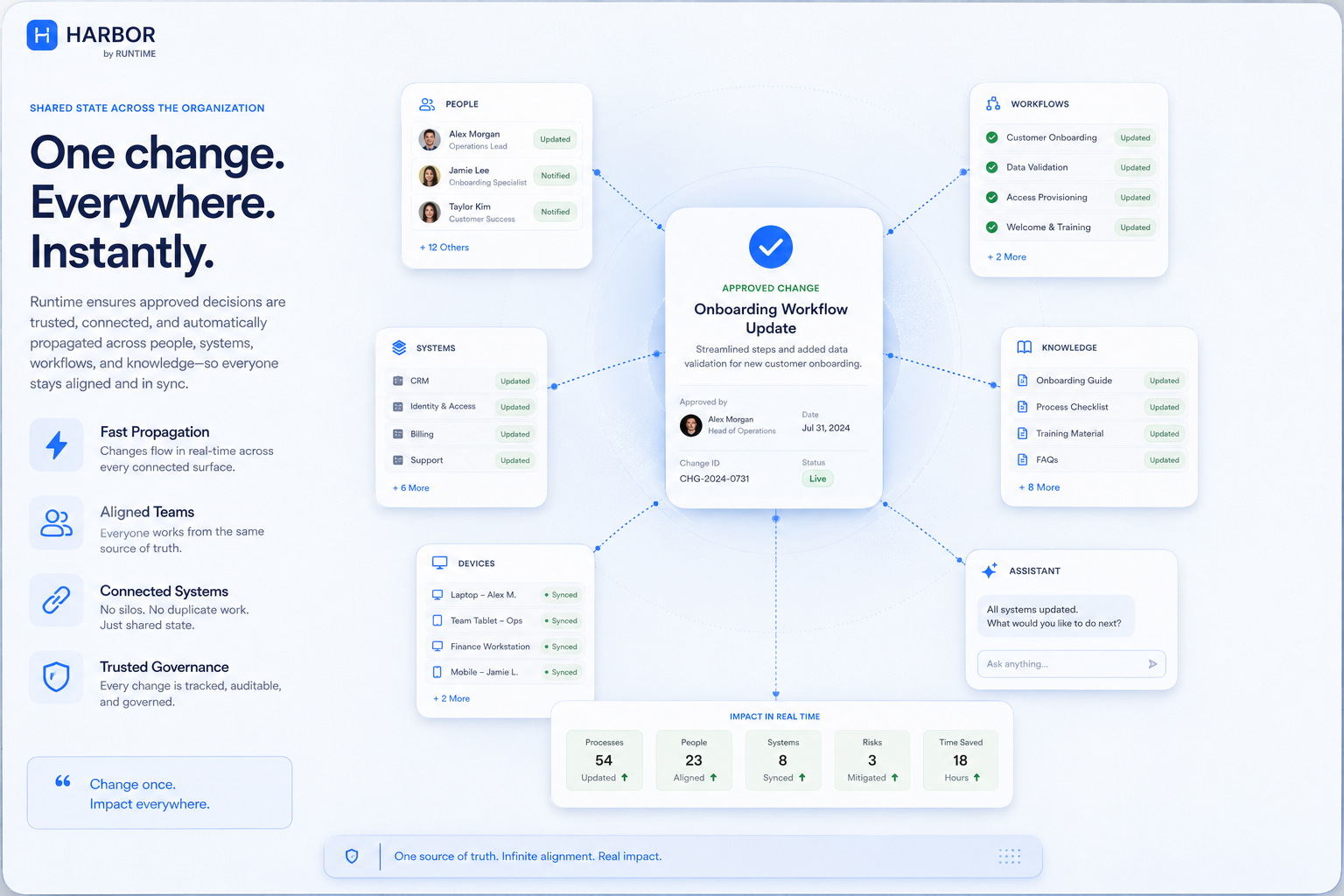
Less “AI assistant.” More continuity system.
The current build is deliberately narrow. Runtime is focused on preserving the reasoning around work — what changed, why it changed, who owns it, what evidence supports it, and what should happen next.
Turns decisions into durable records.
A decision can carry its question, answer, source, owner, approval state, review point and history instead of disappearing into a meeting or message thread.
Shows the same state differently by role.
Harbor demonstrates role-conditioned views of one governed organizational state. People see what they need without creating separate versions of reality.
Makes “what changed?” visible.
The product experience is organized around what changed, what needs attention, what is at risk and what can wait — instead of forcing people to reconstruct context from tools.
Separates knowing from authority.
Runtime distinguishes evidence, recommendation, approval and action. A model can help interpret context; it does not become the source of truth or silently inherit authority.
From scattered context to governed continuity.
The product sits between the tools where work already happens and the people who need to understand what is true now. It is designed to connect sources, not force an organization to start over.
Bring forward evidence.
Documents, messages, interviews and operational sources contribute context.
Make the decision legible.
Ownership, source, status, rationale and review conditions become explicit.
Resolve authority.
Different roles have different visibility and action rights against shared state.
Show what matters now.
Runtime brings forward change, attention, risk and unresolved context.
Carry the why forward.
The next person inherits more than the latest file — they inherit the decision trail.
A calmer operating surface.
Harbor now organizes the experience around the questions a person actually needs answered: what is true now, what changed, what needs me, and what is unresolved.
Pre-launch means the boundaries matter.
Runtime is not presenting a finished enterprise platform. The current build is a bounded pre-pilot system and product reference focused on continuity around real organizational decisions.
That means the site should be clear about what is demonstrated today, what is architecture, and what still needs validation through real usage.
Role-aware surfaces, decision records, approval concepts, source/evidence context and a current-state product walkthrough.
How much continuity actually reduces reconstruction time, repeated questions, approval friction and knowledge loss.
Future-state architecture exists, but it remains subordinate to real usage evidence.
The product is about continuity, not another dashboard.
The overview film shows the core transition: scattered context becomes a shared, governed understanding that can travel with the work.
“The organization remembers anyway. It simply remembers unevenly.”
From What the Organization RemembersRead the founder essay →We are looking for the first real environments where continuity is expensive enough to measure.
Project Runtime is not generally available. If you are interested in an early product conversation, a design-partner environment, or simply following the build, request private preview access.